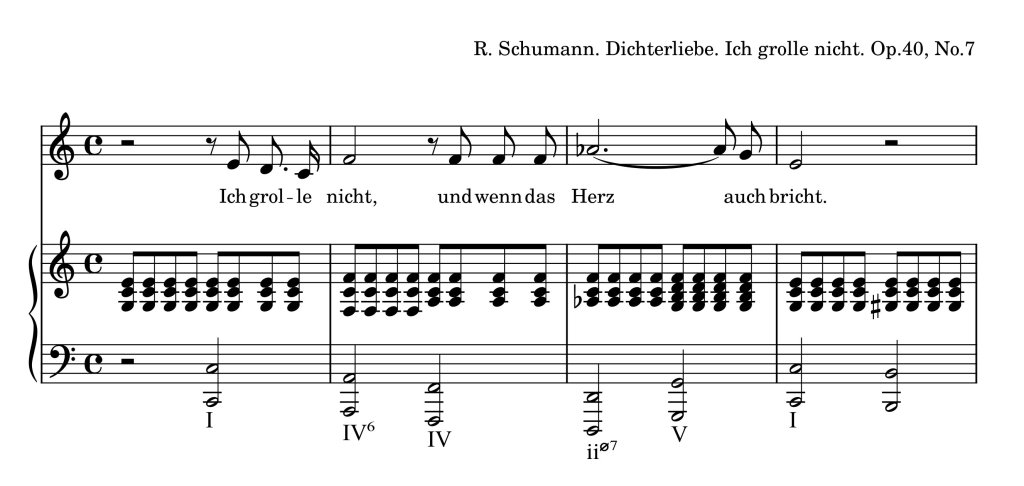
In Robert Schumann’s song “Ich grolle nicht” from Dichterliebe (1840), the composer creates powerful emotional tension through harmonic nuance. One particularly striking technique is the use of the lowered 6th scale degree (A♭) in the seventh chord built on the second degree (II⁷), functioning as part of the subdominant chord group. This chord, borrowed from the harmonic major scale, adds a sorrowful color to the musical expression:
Strikingly, a similar harmonic device appears in a vastly different context: Radiohead’s “Creep” (1992). In the chord progression G–B–C–Cm, the diatonic major 4th scale degree triad (C major)—the subdominant chord—shifts to a minor 4th scale degree triad (C minor), including the lowered 6th scale degree, also borrowed from the parallel harmonic major scale. Though harmonically simple, this substitution has a profound expressive impact, introducing a moment of emotional vulnerability:
Consider this chord progression:

Unfortunately, some of the lyrics slightly ruin this song.
We could say it’s a modern kind of irony.
In both cases, the lowered sixth scale degree, borrowed from the harmonic major scale, functions as a moment in which harmonic color intensifies musical expression. Despite vast differences in era (19th and 21st centuries) and musical style (Romantic Lied and alternative rock), both Schumann and Radiohead employ this technique to unveil emotional depth embedded within their music.

Leave a comment