The sixth chord of the second scale degree (II6 or ii6) is the first inversion of the triad on the second scale degree (II53), also known as a supertonic triad.
II6 is built on the 4th scale degree and belongs to the predominant chord group:
Example 1.

It is often found as a predominant chord in the musical compositions of W. A. Mozart and L. van Beethoven .
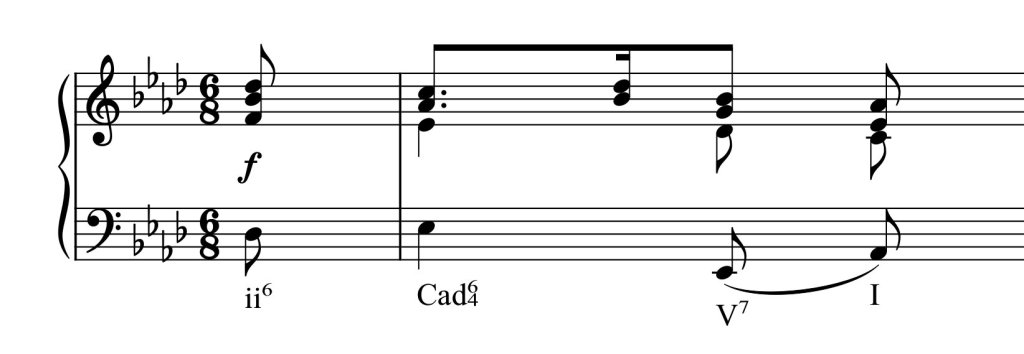
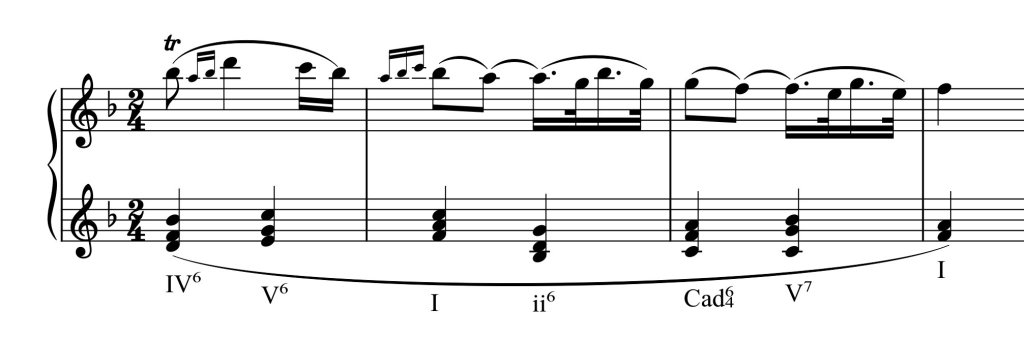
II6 is used in cadences before either Cad64 or V chords when the soprano line moves down from the second to the first scale degree, while the bass simultaneously moves up from the fourth to the fifth scale degree (see Examples 2 and 3).
Example 2.
W. A. Mozart, Piano Sonata No. 2 in F major, K. 280, Adagio, mm. 21-22:
Example 3.
L. van Beethoven, Piano Sonata in F major, Op.10 No. 2, Allegro, mm. 9-12:
Doubling the third tone is most common for ii6 (refer to musical examples 2 and 3), while doubling the root or the fifth is used less frequently.
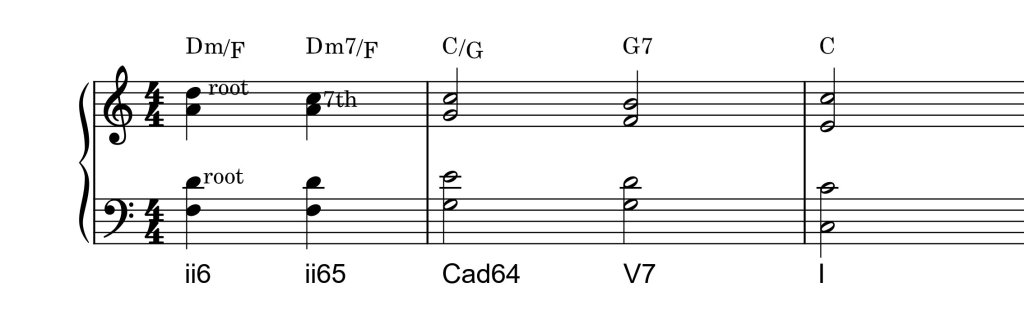
When connecting II6 with II65, it is preferable to double the root:
Example 4.
The Most Effective Use of II6
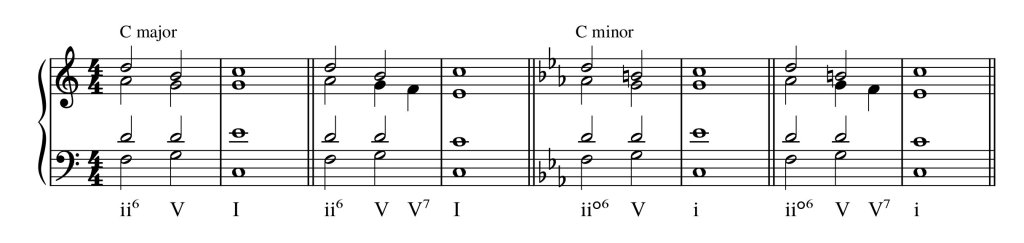
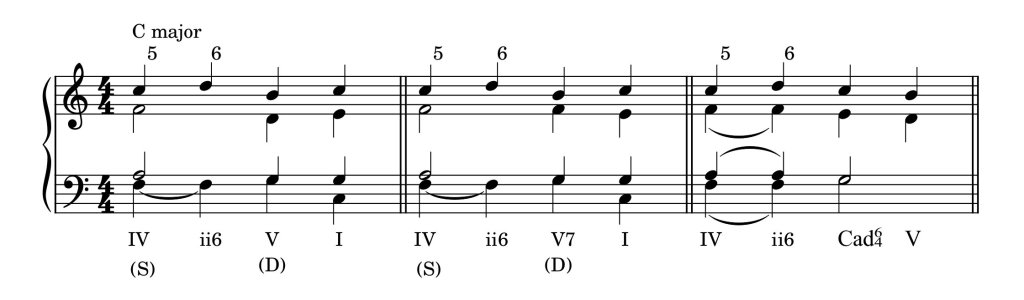
As a predominant chord, II6 is commonly used after I53 (T53), I6 (T6), VI53, IV53 (S53), and before Cad64 (I64), V53 (D53), V7 (D7) in the root melodic position (the 2nd scale degree), with a descending melodic line in the soprano and a corresponding ascending motion in the bass from the 4th to the 5th scale degree:
Example 5.
Typically, II6 is associated with cadential chords and can be interpreted as a subdominant triad with a sixth instead of a fifth:
Example 6.

Leave a comment