The supertonic seventh chord, denoted as II7, is the chord found on the 2nd scale degree.
It is the main seventh chord of the predominant group.
II7 chord has two types of sound and structure: it is a minor seventh chord on the second degree of the major scale, and a minor seventh chord with a diminished fifth on the second degree of both the minor and harmonic major scales:
Example 1.

As with any seventh chord, II7 has three inversions: II65 on the fourth scale degree, II43 on the sixth scale degree, and II2 on the first scale degree.
For example, in the key of C major:
Example 2.

The II7 chord and its inversions can be resolved directly into a tonic chord with a doubled fifth (less often a third) on the nearest degree in the bass.
In this case, the root (second scale degree) resolves upwards to the third scale degree; the third (fourth scale degree) also resolves upwards to the fifth scale degree (less often downwards to the third degree); the fifth (sixth scale degree) resolves downwards to the fifth scale degree; and the seventh of the chord (first scale degree) stays in place as a stable tone. See examples below.
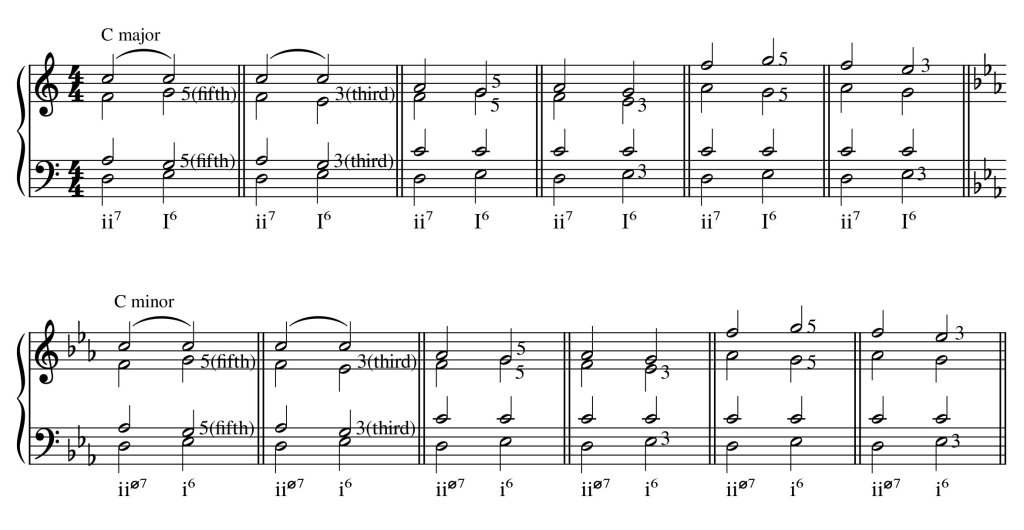
In a four-part (SATB) texture, the II7 chord can be used in various melodic positions and resolve to the I6 (T6) with a doubled fifth (and less often a doubled third) through a harmonic type of connection where a common note stay in the same place:
Example 3.
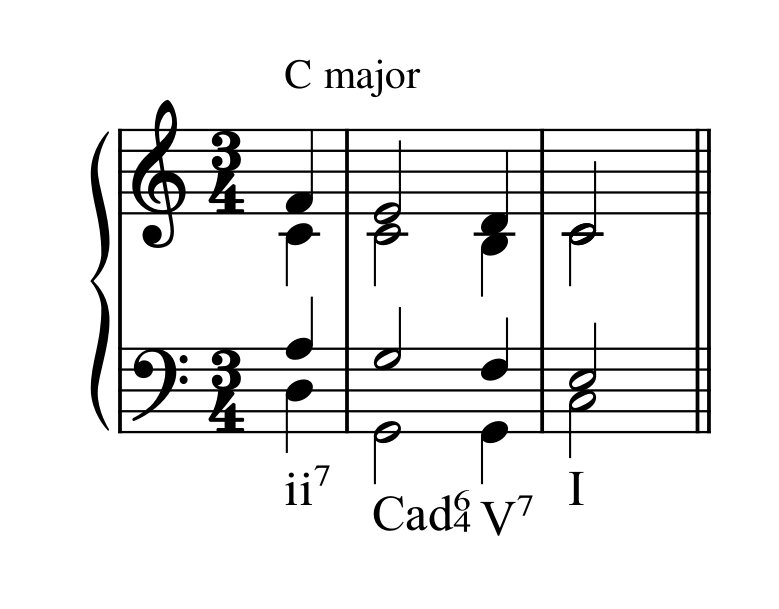
The II7chord is irreplaceable in a cadence when the soprano voice moves from the fourth to the third scale degree. In this case, the II7 chord resolves into the Cad64 chord with a bass leap from the second to the fifth scale degree:
Example 4.
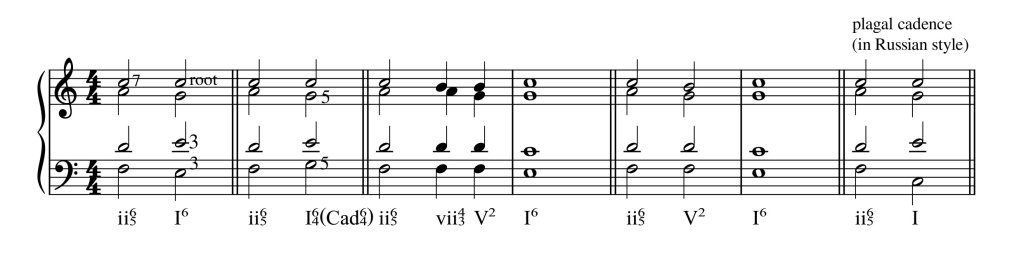
The 1st inversion (II65) resolves into either I6 with a doubled third or fifth, or into the I64 (T64 or Cad64) with a doubled fifth:
Example 5.
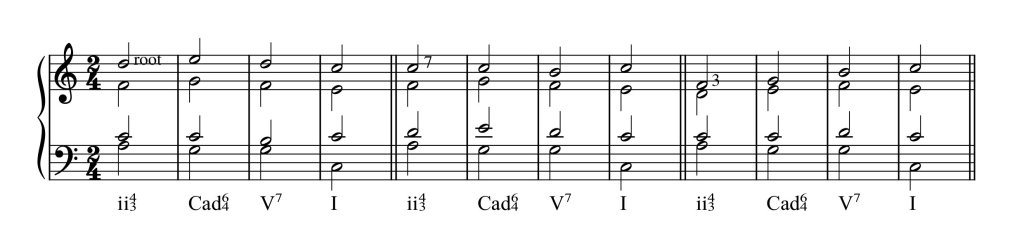
The 2nd inversion (II43) resolves into I64 (T64 or Cad64):
Example 6.
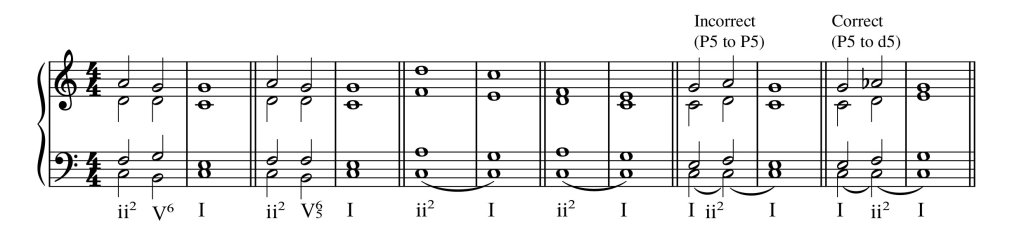
The 3rd inversion (II2) moves into the first inversions of the fifth scale degree chords (V6 and V65), and it can also resolve into the tonic triad (I53 or T53) with a doubled root or fifth:
Example 7.
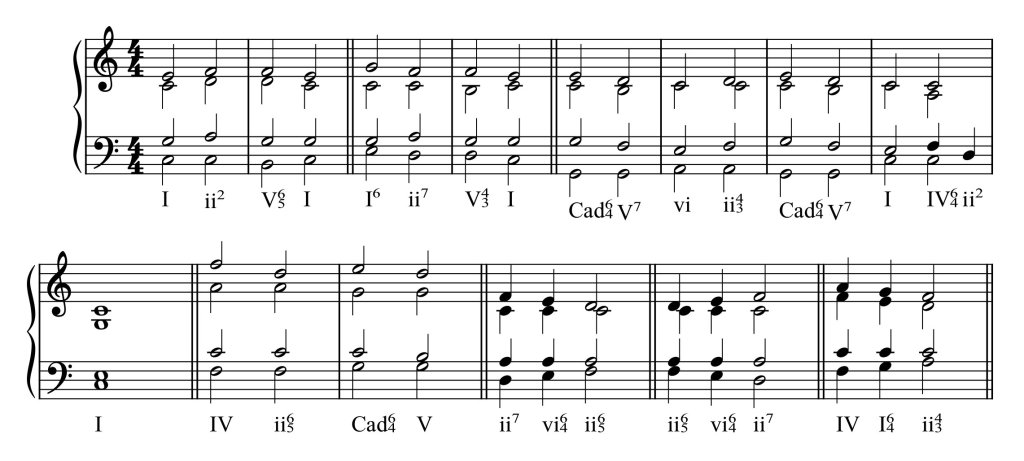
As a predominant, II7 chord and its inversions are often used in progressions before dominant chords, following these chords: I53, I6, VI53, IV53, IV6, II6, and only in a major after II53.
Here are some commonly used chord progressions that include these chords:
Example 8.
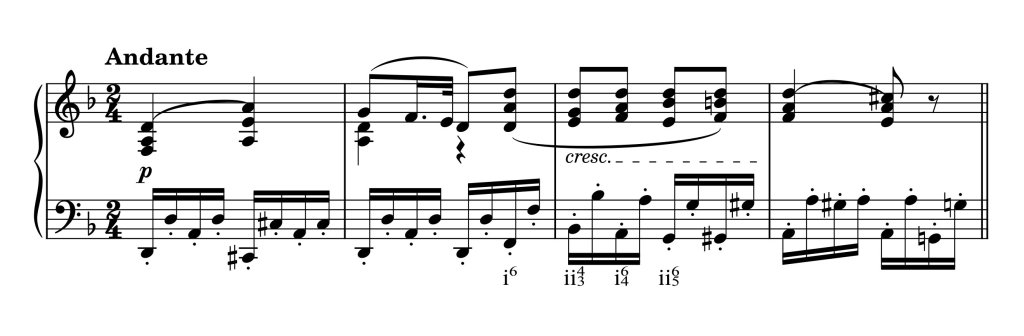
We can find the II7 chord and its inversions in the music of Beethoven’s music.
Example 9.
L. van Beethoven, Piano Sonata in D major, Op. 28, Andante, mm. 1-4:
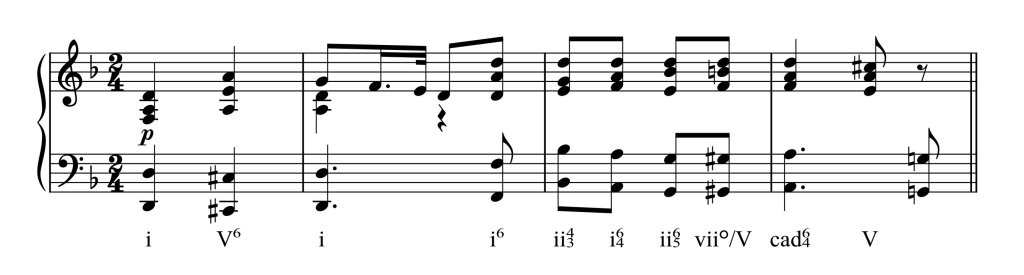
Let’s take a closer look at the chord progression in this example of classical harmony from Beethoven:
Example 10.
The II7 chord is also one of the primary harmonic elements in jazz.

Leave a comment