A leading-tone seventh chord (symbolized as VII7) is built on the 7th scale degree (called the leading tone).
As a member of the dominant chord group, it typically resolves to the tonic triad.
VII7 has two variations of sound and structure:
Example 1.
- the diminished seventh chord, which is found in both the harmonic minor and harmonic major scales:
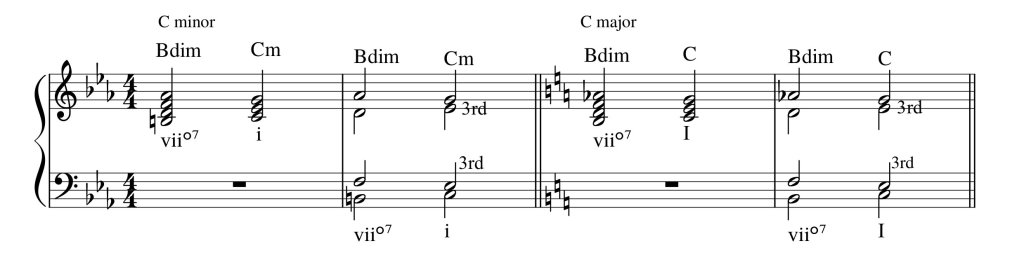
2. the half-diminished seventh chord on the 7th scale degree of the natural major scale:
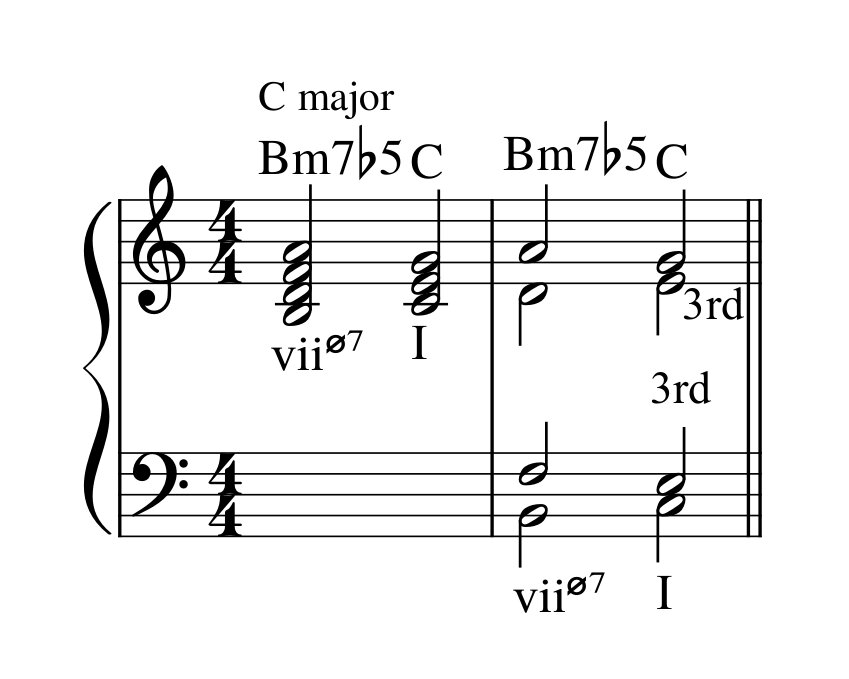
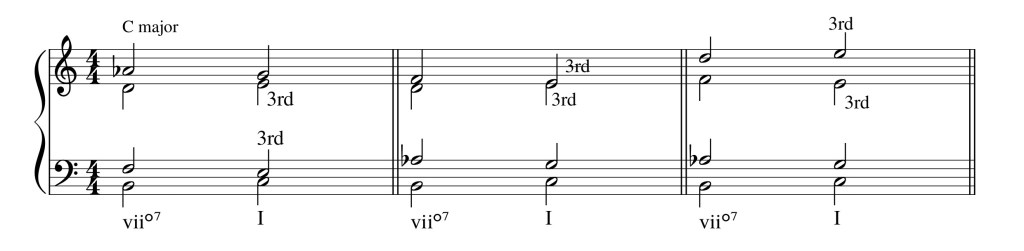
In a four-part harmony (SATB), each of the four notes of the leading-tone seven chord has a specific resolution: the 7th degree (root tone) resolves upward to the 1st degree of the scale; the 2nd degree (third tone) also resolves upward to the 3rd degree; the 4th degree (fifth tone) resolves downward to the 3rd degree; and the 6th degree (seventh tone) resolves downward to the 5th degree:
Example 2.
As with any seventh chord, VII7 has three inversions: VII65 with the 2nd scale degree in the bass, VII43 with the 4th scale degree in the bass, and VII2 with the 6th scale degree in the bass.
VII65 and VII43 can resolve directly into the first inversion of the tonic triad–the sixth chord (I6) with a doubled third.
In this case, a melodic type of the chord connection is formed, as VII7 and tonic triad (I53) do not share any common tones:
Example 3.
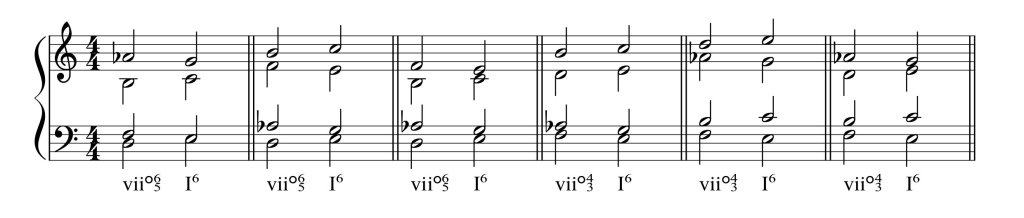
Thus, VII7 resolves into I53 with a doubled third, while VII65 and VII43 both resolve into I6 with a doubled third.
VII2 can not resolve into I64, but it can move into the dominant seventh chord (D7 or V7).
Example 4.
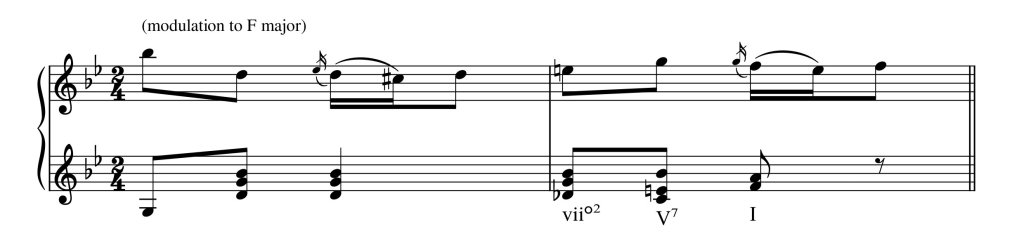
Polka op. 39, No. 14 from Children’s Album by P. Tchaikovsky, the full final cadence of the first period, mm. 7-8:
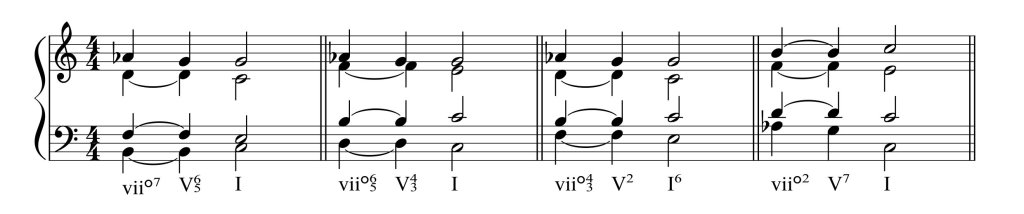
The VII7 chord and its inversions can transition into dominant chords on the same or a neighboring scale degree in the bass, facilitated by the smooth harmonic connection between the chords. Three notes of the VII7 chord remain in place, except for the seventh tone (the 6th scale degree), which moves down to the root of the dominant chord (the 5th scale degree). Subsequently, the dominant chord resolves into the nearby tonic chord:
Example 5.
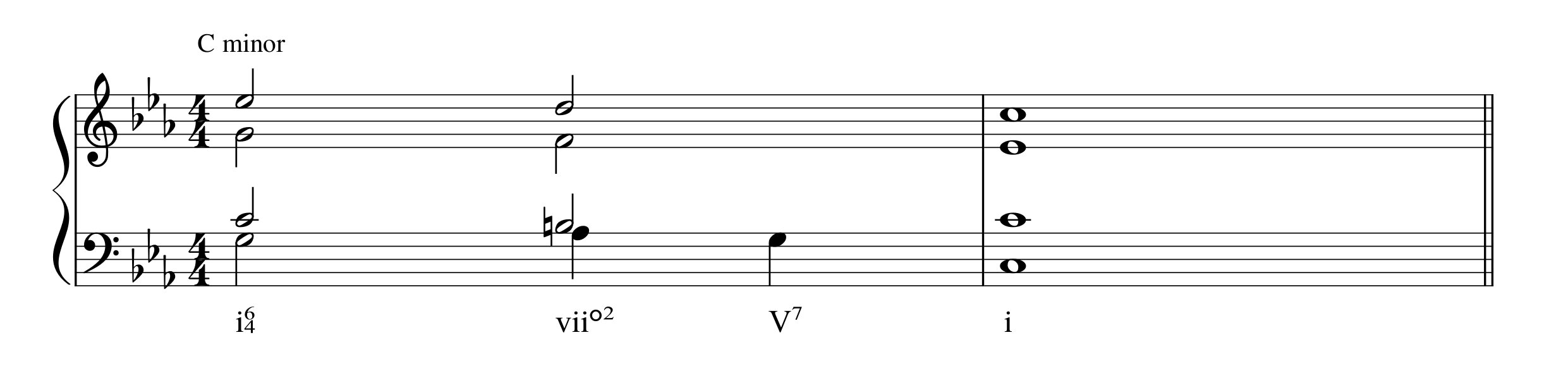
As mentioned above, VII2 can be used in the final full cadence before V7:
Example 6.
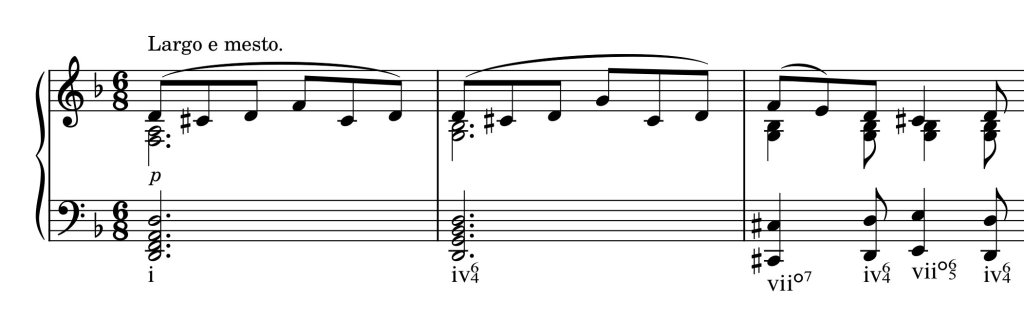
The next example shows a leading-tone seventh chord and its first inversion (VII65) in the musical context of the first period in the second movement (Largo e mesto) of Beethoven’s Piano Sonata in D major, Op. 10, No. 3, mm. 1-3:
Example 7.
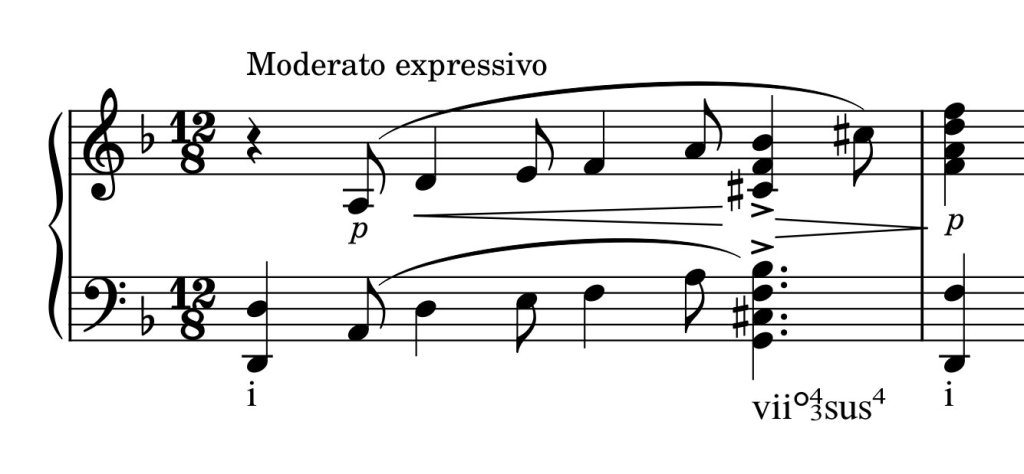
In S. Rachmaninoff’s compositions in minor keys, the second inversion of the diminished leading-tone seventh chord (VII43), when it contains a fourth instead of a third tone, can be encountered. This chord resolves into the tonic triad and can be found in “The Old Man’s Tale” from the opera “Aleko”, mm. 32-33:
Example 8.
A leading-tone seventh chord (VII7) is one of the main chords in jazz where it is most often used as a secondary leading-tone seventh chord.
Here are some common jazz progressions with a leading-tone seventh chord (VII7).

Leave a comment