The pentatonic scale is a musical scale with five notes per octave. It is one of the most widely used scales in various forms of music, including folk music, rock, jazz, and many others.
The term “pentatonic” comes from the Greek words “penta,” meaning five, and “tonic,” meaning tone.
There are several types of pentatonic scales, but two of the most common are the major pentatonic scale and the minor pentatonic scale.
The major pentatonic scale is formed by taking the 1st, 2nd, 3rd, 5th, and 6th degrees of the major scale. For example, in the key of C major:
Example 1.

The minor pentatonic scale is formed by taking the 1st, 3rd, 4th, 5th, and 7th degrees of the natural minor scale.
For example, in the key of A minor:
Example 2.

In other words, to create a pentatonic scale, you need to remove two degrees from a major or minor scale, between which a tritone interval is formed:
Example 3.
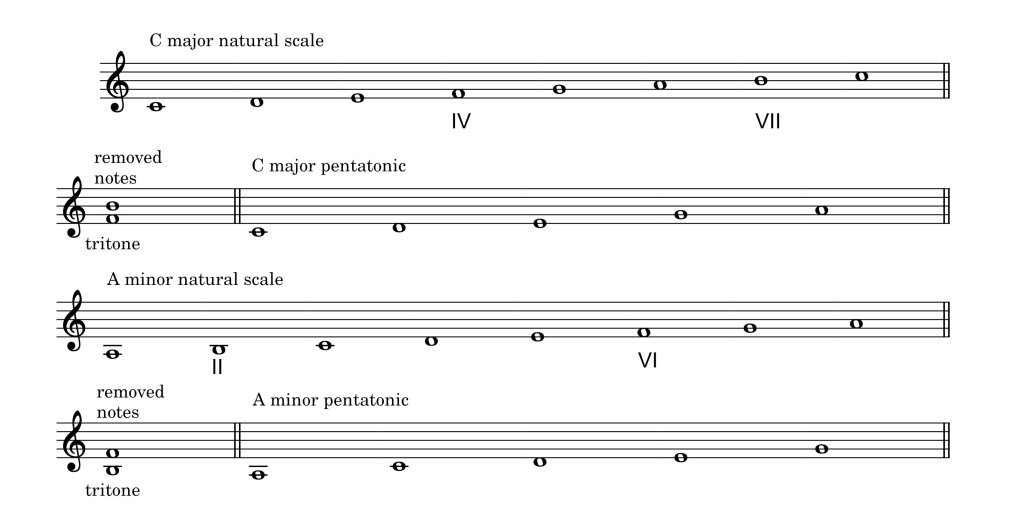
The pentatonic scale consists of two trichords, unlike the seven-step diatonic scales, which consist of two tetrachords. A trichord (from Greek trixordos – three-stringed) is a three-step anhemitonic scale that does not contain semitones, a characteristic of the pentatonic scale:
Example 4.

It’s amazing that pentatonic scales have existed for such a long time. They were developed independently by many ancient civilizations and are still found in traditional music from various cultures around the world, including Asian, African, Native American, and Celtic music. Its simplicity and adaptability make them a fundamental element in the musical vocabulary of musicians across different genres and traditions.
Example 5.
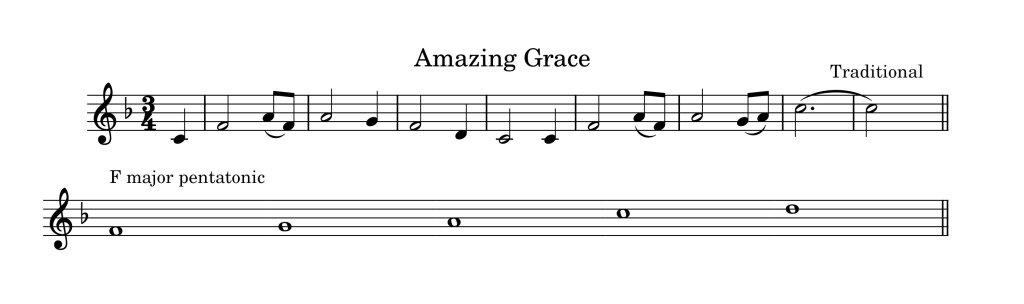
Example 6.
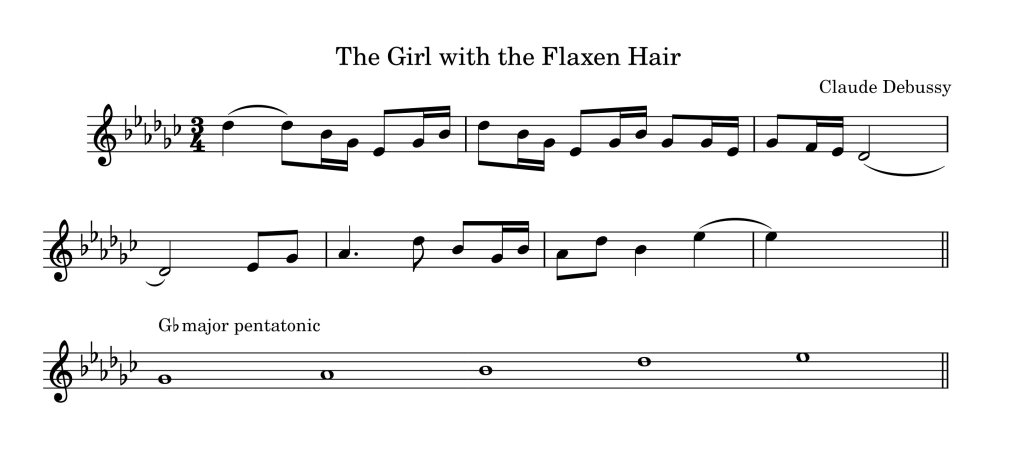
One of the key features of the pentatonic scale is its versatility. It is often used in improvisation because its simple structure makes it easy to create melodies that sound good over a wide range of harmonies.
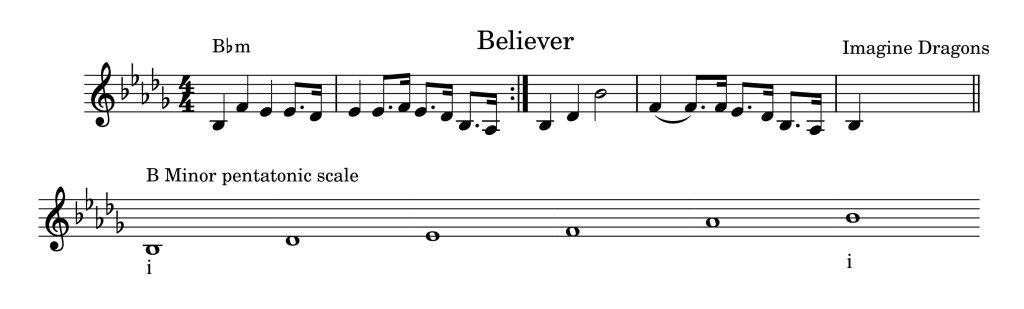
A lot of popular songs are based on the pentatonic scale.
Example 7
It is obvious that the pentatonic scale is the basis of the blues scale:
Example 8

 Music theory explained
Leave a comment