The concepts of “mode” and “scale” in music theory are related, but they are not exactly the same. Both refer to sets of pitches or notes used in music, but they serve different purposes and have different implications.
Nevertheless, articles and videos sometimes use terms “mode” and “scale” interchangeably, which can be confusing.
I guess that the development of the modal framework has been influenced by musicians’ aspirations to expand the expressive capabilities of modes as a system of pitches—beginning with modal pentatonic scales, progressing to seven-note modal diatonic, then transitioning to the tonal major-minor framework, which includes variations like harmonic minor, harmonic major, and others, and ultimately reaching the chromatic tonality and artificial modes found in compositions by M. Glinka, N. Rimsky-Korsakov, C. Debussy, O. Messiaen (Modes of limited transposition), and other composers.
We can say that a mode is a set or framework of pitches organized into scales, which include specific degrees.
In other words, the scale is a series of ordered pitches, usually arranged by pitch height. It’s the raw material (similar a palette in painting) from which melodies and harmonies are built.
The number of notes in a scale can range from five (pentatonic scales):
Example 1
Major pentatonic

to twelve (chromatic scale):
Example 2

The most common scales in Western music are the major scale and the harmonic minor scale:
Example 3

They are serve as crucial tools for creating contrast, much like the interplay of light and shadow in painting. For example, the major scale is usually associated with happy and joyful music, while the minor scale is often associated with sad and melancholic music.
Compared to the natural minor scale, the seventh scale degree of the harmonic minor is raised by a semitone. This alteration creates an augmented second interval between the sixth and seventh scale degrees, contributing to the expressiveness of its sound.
Play and sing the scales below:
Example 4

Modes are derived from scales, often by starting and ending on different degrees of the scale. They are used to create different moods and emotions in music. Play, sing, and compare the examples provided below on this page.
The ancient Greeks used the term “mode” for all the different note sequences they had.
The ancient Greek modes served as the foundation for much of Western music , influencing composers throughout the Middle Ages, Renaissance, and beyond.
The ancient Greek modes were based on tetrachords (four-note scales). From these tetrachord combinations, seven distinct diatonic modes emerged, each with a specific character and emotional association.
Example 5.1
The Ionian mode is equivalent to the major scale and is frequently used in classical, folk, and popular music. It sounds like the natural major scale (compare it with the C Major scale from Example 3):

Example 5.2
The Dorian mode is a minor mode with a bright and sometimes ecstatic sound.

Example 5.3
The Phrygian mode is a minor mode with a dark and mysterious sound.

Example 5.4
The Lydian mode is a major mode with a bright and airy sound, often used in folk and world music.

Example 5.5
The Mixolydian mode is a major mode with a bluesy sound, commonly used in folk, rock, and jazz music.

Example 5.6
The Aeolian mode is the same as the natural minor scale and is often used in classical and folk music.

Example 5.7
The Locrian mode is a minor mode with a dark and dissonant sound. This mode is not as commonly used as the other modes due to its highly distinctive sound due to diminished fifth in the root:

It’s worth noting that Ionian, Lydian, and Mixolydian scales create a brighter, more ‘major-like’ sound due to the presence of a major third interval between the first and third scale degrees. Conversely, Aeolian, Dorian, and Phrygian scales create a darker, more ‘minor-like’ sound because of the minor third interval between the first and third scale degrees.
It’s clear that in modern musical practice and theory, the terms ‘mode’ and ‘scale’ are nearly interchangeable. We can say now that the famous tune by Beatles is in the mixolydian major with a lowered leading tone:
Example 6.1
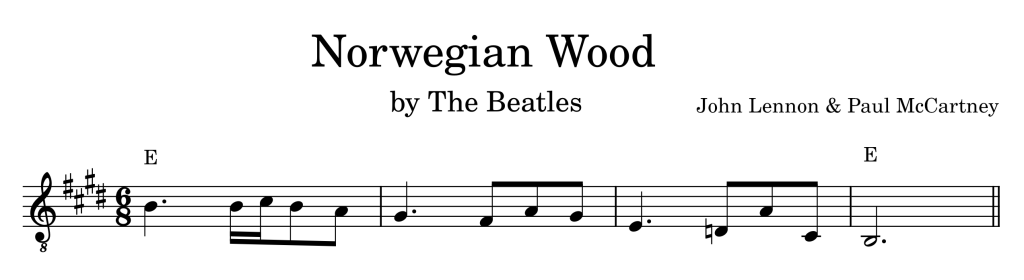
This is the E Major mixolydian scale:
Example 6.2

Other Modes and Scales
Example 7.1

Double harmonic major (also known as the Arabic scale):
Example 7.2

Harmonic minor:
Example 7.3

Double harmonic minor (also known as the Hungarian or Gypsy Minor scale):
Example 7.4

Melodic minor:
Example 7.5

Blues scale
There are various interpretations of the blues scale. However, they all agree that the blues minor and major scales are derived from the minor and major pentatonic scales.
Essentially, the blues scale, also known as the hexatonic scale, is a chromaticized version of the minor and major pentatonic scales.
The A minor and C major blues scales share the same set of notes but start on different degrees, similar to ancient Greek modes:
Example 8.1


Leave a comment